Gift Card Vendor vs Rewards Platform: What Is the Difference?
One sells codes, the other gives them out as rewards. Who pays whom is the whole difference — and it is also the fastest way to spot a fake of either kind.
A gift card vendor sells you a code: you pay money, you get a card. A rewards platform pays you a code: an advertiser pays the platform for your attention, and the platform passes part of that to you as a card. Both deal in the same Amazon and Google Play codes; what differs is who pays whom.
How a gift card vendor works
Vendors include the brand itself (Amazon sells its own gift cards), large resellers that sell to companies for employee rewards, and shops that sell physical cards. The vendor buys codes from the brand — usually at a small discount — and sells them at or near face value. Its customer is the person or company paying.
- You pay: money.
- You get: a code of exactly the value you paid for.
- The vendor earns: the small discount it buys at.
How a rewards platform works
A rewards platform — like Superhappen — is paid by advertisers, not by you. Watching a video to the end, finishing a survey or completing an offer earns the platform money; a share becomes your coins; and when your coins reach a card's price, the platform buys a real code from a vendor and gives it to you.
- You pay: time and attention.
- You get: a small code, usually ₹2 to a few hundred rupees.
- The platform earns: the difference between what advertisers pay and what the codes cost.
So a rewards platform is a vendor's customer. Every legitimate code a rewards app hands out was bought from a vendor first. The full economics are in how reward apps make money.
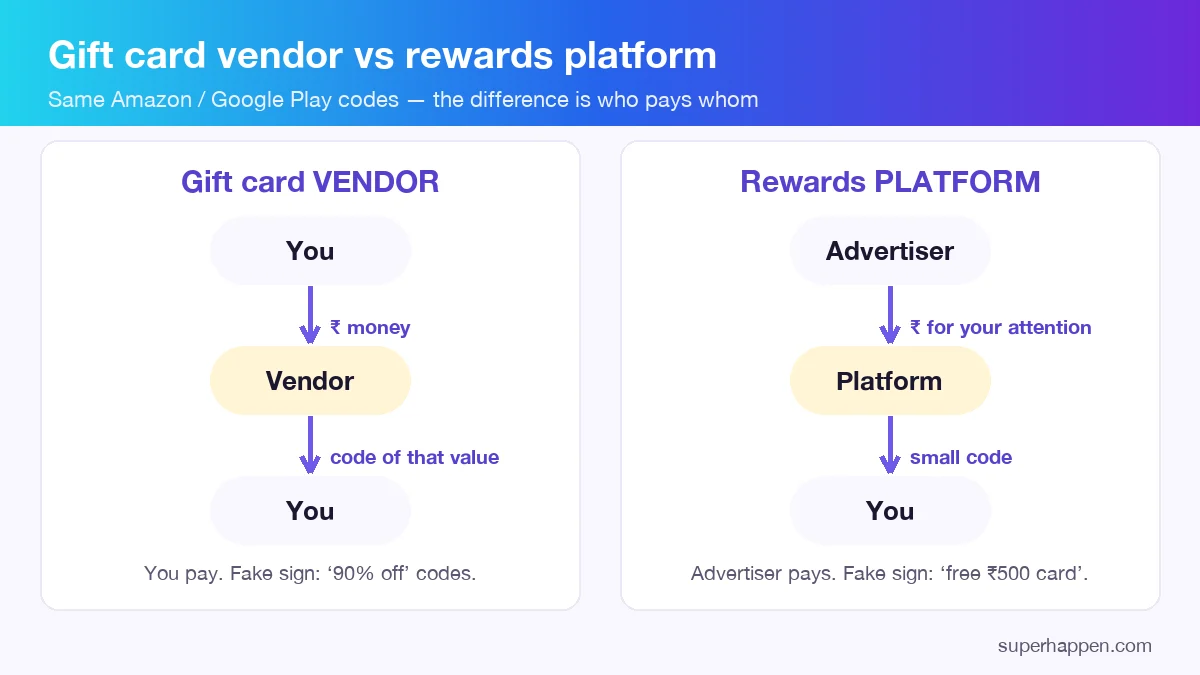
Side by side
| Gift card vendor | Rewards platform | |
|---|---|---|
| Who pays | You | Advertisers |
| What you give | Money | Time and attention |
| Card value | Any denomination you buy | Small, earned over days |
| Speed | Instant after payment | After you reach the price |
| Typical fake | "90% off" codes that are stolen or used | "Free ₹500 card" that never arrives |
How to spot a fake of either kind
A fake vendor sells codes far below face value. Real vendors work on thin margins; a ₹1,000 card for ₹300 is stolen, already used, or does not exist — and a card bought with a stolen payment can be cancelled by the brand after you have added it.
A fake rewards platform promises large cards for tiny tasks, asks for a "withdrawal fee", or asks for your password or OTP. A platform that pays out of advertising money cannot afford large cards, and never needs your login. The common patterns are in reward app scams in India.
Which one should you use?
If you need a specific amount today, buy it from the brand or an authorised seller. If you want small cards over time without spending money, a rewards platform is the honest route — redeem the cheapest card first to make sure it pays. Either way, a code is added the same way; see how to add an Amazon gift card to your balance.